Choosing the right gate type for your property is an important decision. It impacts not only the security and curb appeal for your home but also the daily convenience of accessing your driveway. When considering gate mechanisms, it is important to note that there are two main options: sliding gates and swing gates. While both offer excellent security and automation capabilities, their uses depend heavily on the unique characteristics of your property and driveway layout.
The Ultimate Deciding Factor When Choosing a Gate
The physical space you have available is more often than not one of the most important factors to consider when choosing your gate type.

Sliding Gates: The Space-Savvy Choice
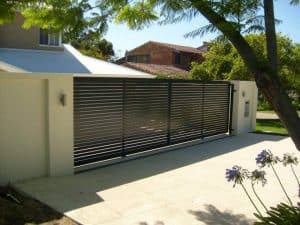
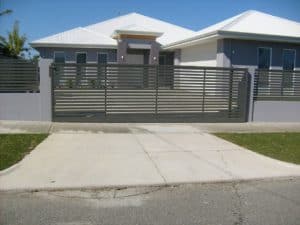
Sliding gates operate by moving horizontally along a track, parallel to your boundary fence or wall. They offer security and optimise the properties that have limited space for a swing gate. Sliding gates come in both an automatic option (utilising a motor) or a manual sliding option utilising a parrot beak lock to close the gate.
| Sliding Gate Space Requirements | How it Affects Your Driveway |
|---|---|
| Need Clear Side Space (Run-Back) | The gate requires a clear run-back area along the fence line equal to its width plus a little extra for the motor and mechanism. |
| Saves Driveway Depth | Sliding gates are ideal for properties with short driveways, driveways that lead straight into a garage, or entrances very close to a busy road, as they do not require any inward or outward space, leaving more room for vehicles on the driveway itself. |
| Perfect for Slopes | They are the most practical solution for driveways with a significant uphill or downhill slope, as the horizontal movement is unaffected by the incline. |

Swing Gates: The Traditional Choice
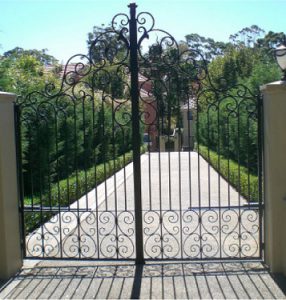
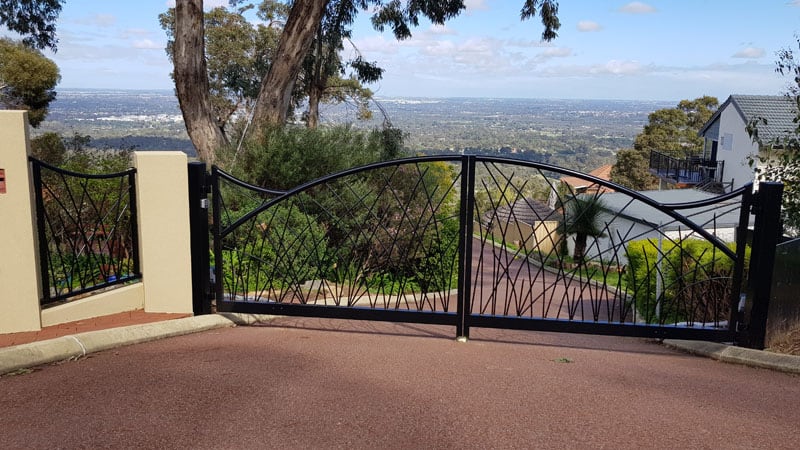
Swing gates are mounted on hinges and open inward, sometimes outward, and in an arc, much like a traditional door would. They can be either manual or automated and come in a number of different colours and designs to match your house. They can also come in a single or double configuration with a variation of lock options, depending on your choice of single or double gate. Double gates are best to have a lock latch with a drop bolt at the bottom.
| Swing Gate Space Requirements | How it Affects Your Driveway |
|---|---|
| Needs Clear Driveway Depth | They require a clear, unobstructed arc of space for the gate to swing open fully. If you opt for a double swing gate, the swing distance is halved, which is a great space-saver for wider entrances. |
| Saves Side Space | They are the best choice for properties that have beautifully landscaped front gardens or short boundary lines that don’t allow for the side run-back required by a sliding gate. |
| Requires Flat Ground | Swing gates mostly require a relatively flat, level driveway. A steep incline can be catered for, but usually will result in a gap under the gate, and the gate itself is longer than a standard gate to allow for the slope. If the gate is inside the property, it can also be opened outward. |
Budget and Installation Complexity
When you compare the two different types of gates, it is important to look at the initial installation cost versus the maintenance is in the long term.
Swing gates are generally a cheaper alternative for the initial purchase and installation. Their mechanism is a lot simpler, making the overall installation process quicker. Sliding gates, however, typically come with a higher upfront cost because they require more complex groundwork and installation.
Long-Term Maintenance
Whilst swing gates have fewer moving parts, making them simple to maintain, they can be a lot more susceptible to wind damage on the hinges over time, especially if you live closer to the salty Perth breeze on the coastline. Given the sliding gates’ robust design, it often means that there are fewer mechanical issues. They do, however, require the track to be kept clean and clear of debris to ensure smooth operation, but such maintenance is minimal and easy to perform.
Security and Performance Needs
Choosing an automatic swing or sliding gate offers a significant security advantage over a manual gate system. The operating mechanism offers a different level of physical security and performance stability.
Sliding gates offer superior physical security. The way the gate interlocks and the motor locks it into place makes it exceptionally difficult to force it or pry it open. On the other hand, swing gate hinges can be seen as a minor vulnerability if not paired with a robust locking system.
- Wind Resistance: Sliding gates are highly stable in strong winds due to their support track and their straight-line sliding direction. A large, solid swing gate in certain environments can act almost like a sail, putting considerable stress on hinges or a motor (if automatic) in high wind conditions.
- Durability: Sliding gates are often favoured for commercial or high-traffic properties due to their inherent solidity and streamlined operating mechanism. Swing gates are highly reliable when installed on level ground, which makes them an excellent choice for residential areas with mostly flat driveways.

Which One Suits You Best
The first step is to measure and assess your area to see what available space you have on your property. Your property restrictions, such as driveway space and orientation, can restrict what options you have when it comes to deciding between a swing gate or a sliding gate. The team at Feature Fencing can also work with you to discuss your needs and recommend the ideal manual or automatic gate solution that fits perfectly with your property.